
The Largest Infrastructure Buildout in Human History
OpenAI, Power, and the Invisible Rails of Intelligence Built Through Partnerships

Welcome to my biweekly newsletter covering a range of topics within the deal making space. Join a bunch of curious folks here.
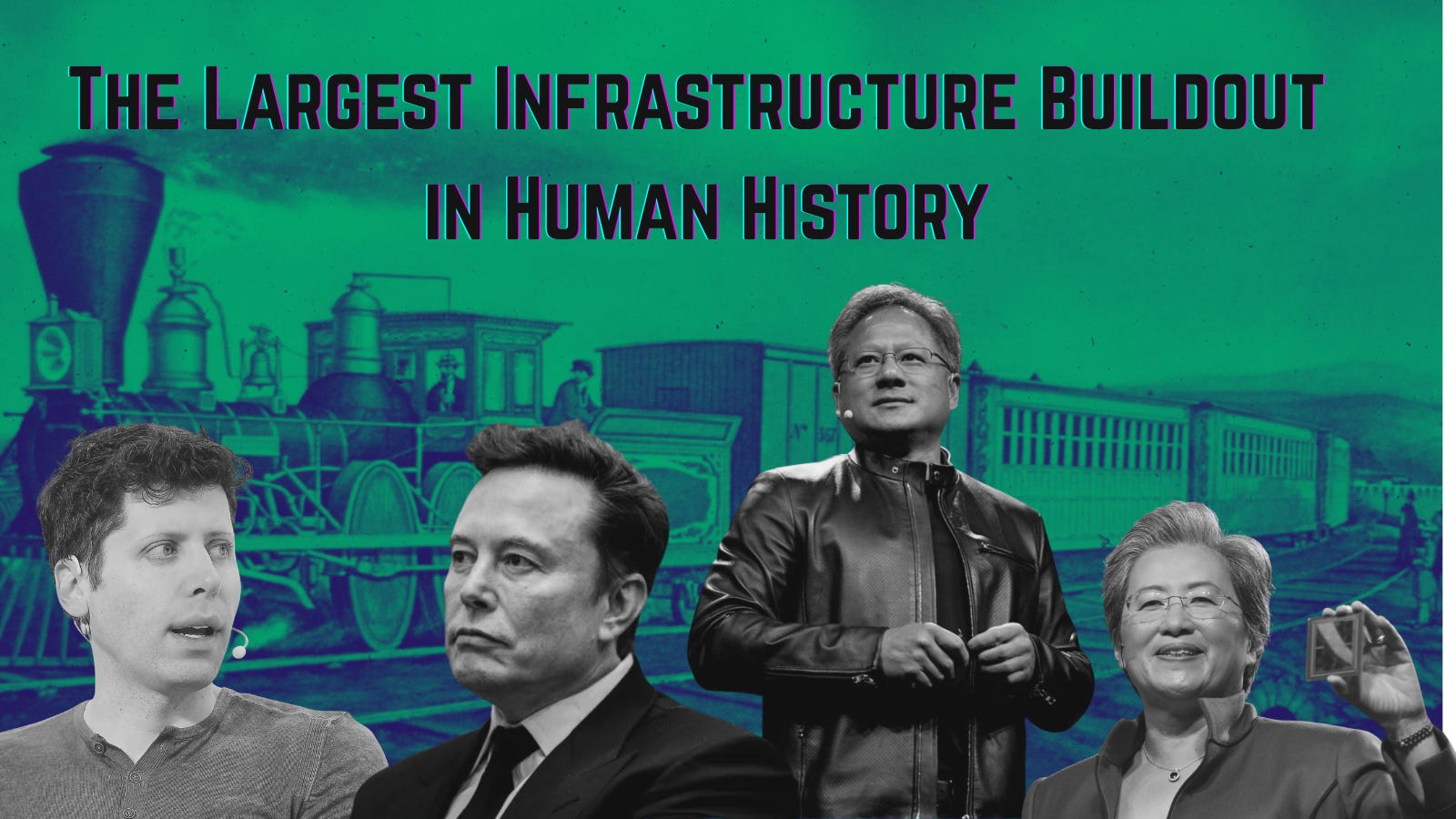
Every generation builds something that changes how humanity works.
In the 1800s, it was the railroads, a network that connected cities, markets, and people. In the 1900s, it was the power grid, a web of electricity that lit our nights and powered our industry. In the 2000s, we built the internet, turning information into oxygen for the digital age.
Now, we are building something even larger. The biggest infrastructure buildout in human history. This time, it’s about intelligence.
The Global Effort Behind OpenAI’s Infrastructure Buildout
OpenAI’s rise has triggered a global chain reaction. Behind ChatGPT’s friendly interface lies an ecosystem that spans continents. Power plants, chip factories, cooling systems, transmission lines, and data centers are emerging in deserts, fjords, and cornfields.
NVDA 0.00%↑ , MSFT 0.00%↑ , BlackRock, and Elon Musk’s xAI recently joined forces to acquire Aligned Data Centers for forty billion dollars. It is the largest data center deal in history and marks the first major move in their AI Infrastructure Partnership to build the physical backbone of the AI age.
OpenAI and AMD 0.00%↑ signed a multi-year agreement to deploy six gigawatts of GPUs, one of the largest compute expansions ever announced. That deal cements AMD as a core partner powering OpenAI’s next generation of models.
Energy companies are securing long-term power contracts measured in hundreds of gigawatts. Governments are reshaping industrial policy around this new energy race. Japan is investing through sovereign AI funds, the United States is pushing forward with the CHIPS Act, and the Gulf states are establishing state-backed compute hubs.
It feels like an industrial revolution disguised as software.
Why So Many Deals, and Why Measured in Gigawatts?
When people hear about OpenAI’s partnerships with power providers or data center operators, they often wonder why so many. Why are tech companies suddenly talking in gigawatts instead of users or lines of code?
Because compute has become the new currency of intelligence.
You can’t measure this ecosystem by counting chips anymore. The number of GPUs alone doesn’t define capability. The efficiency of the chips, the layout of the systems, and the conversion of energy into compute all matter more. Sam Altman often frames it as a race for “the most intelligence per watt.”
Think back to the railroads. At first, people believed that more track meant more value. But not every mile of track carried the same weight. A mile connecting two industrial hubs could power an economy, while another mile through empty land might see only a few trains a week. It cost the same to build but added far less value.
What defined the success of a railroad was not how many miles it spanned, but how efficiently goods moved across the system. The speed, the connections, and the flow of energy determined its true worth.
Now replace railroads with the infrastructure of AI.
The GPUs are the tracks, the streams of data are the trains, and the goods are the intelligence being processed.
Having more GPUs doesn’t automatically make the system better. What matters is how well they are connected, how efficiently they move data, and how much intelligence per watt the entire network produces.
The watt has become the unifying metric that captures the full chain of intelligence, from the power plant to your ChatGPT query.
Why We Need All This Power
Skeptics call it another bubble. They compare it to the dotcom boom or the crypto craze. But that misses something deeper.
Anyone who has used AI seriously, not casually, but as part of their daily work, knows how much potential still lies dormant. I’ve often felt frustrated when ChatGPT or Gemini completely misunderstood what I was trying to say or created images that missed the point. They are smart, but not yet intuitive. They still fail to connect ideas the way we do naturally.
The vision inside OpenAI and its peers is that every person will have a hyper-personalized AI that acts as an extension of their creativity, intuition, and workflow. But this requires massive compute power, which translates directly into data centers and energy.
This isn’t inefficiency. It’s the cost of simulating intelligence at a personal level for billions of people. We are not building machines to replace us. We are building machines that amplify us, just as previous revolutions did with steam, electricity, and silicon.
Infinite Creativity Meets Infinite Compute
Everyone has asked themselves whether AI will replace them. Replace their job. Replace their purpose.
I asked the same questions until I came across a Substack essay titled How to Be an Artist in the Age of AI by Utsav Mamoria. One line stayed with me:
AI will not make art that surpasses human-made art for one important reason.
Intentionality.
Human creativity is infinite, and that is why we will use all this power. AI will not replace imagination. It will expand it. Any idea can now be brought to life without the barriers that once required years of training or specialized skills. It will help us build, design, write, and experiment at the pace of thought.
Each person carries a unique dataset which is a lifetime of memories, struggles, triumphs, and cultural context that no machine can replicate. In that sense, our DNA holds petabytes of lived experience. AI can collaborate with it, surfacing ideas buried deep in that data and turning them into something new. The future is the merging of infinite compute with infinite creativity.
The New Railroads of Intelligence
When you read about OpenAI signing energy deals or Microsoft announcing another ten billion dollar data center, remember this is not just about chips. It is about civilization laying the new rails of intelligence.
We are building invisible infrastructure that will one day feel as ordinary as power lines or fiber optic cables. And perhaps in the near future, when your personal AI helps you create something extraordinary like a story, a design, a discovery… we will look back and realize this was never just about machines learning to think. It was about humanity expanding its true potential.