
Reading Body Language: The Skill That Wins Deals (Part 1)
Why the best deal makers watch more than they talk

Welcome to my biweekly newsletter covering a range of topics within the deal making space. Join a bunch of curious folks here.
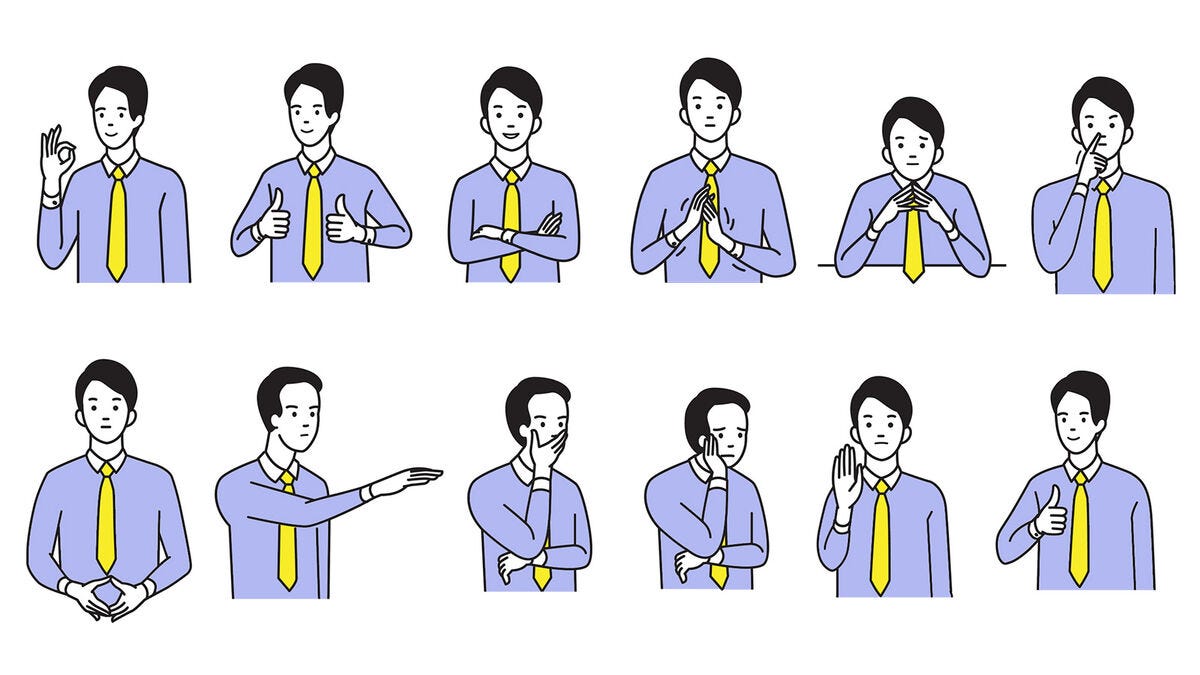
Over the break, I reflected on the deal making skills that have made me better. What I realized is that these skills transcend partnerships as I use them daily, and they’ve fundamentally changed how I see everything. I rarely speak about this openly because it’s been a secret weapon of mine, something most people haven’t studied as a science.
Studying this has been life changing. As humans, we’re constantly negotiating—whether it’s getting your child to eat, making sure your partner is happy with your holiday choice, or closing a billion-dollar deal.
To do this well, you need information. The more you have, the better your next decision and the closer you get to what you want, whether short term or on the grander chessboard you’re playing on. Non-verbal behavior comprises 60-65% of all interpersonal communication. Most people get this and it’s why we’re back in the office and why important meetings still happen in person.
There’s a lot to cover, so I’m breaking this into parts. This is a summary of Joe Navarro’s book What Every Body is Saying, with my personal reflections. Let’s dive into a recent experience...
The Pitch That Died in Real Time
Last month, I watched a founder pitch his partnership to us. His presentation was tight, numbers were solid. Fifteen minutes in, he’s crushing it... or so he thought.
I saw something he didn’t: Three minutes into his product overview, one of the execs’ lips compressed into a thin line. Gone. Like someone hit the mute button on his face. Then came the self-soothing—hand to neck making his hand into a V-shape rubbing his throat. His eyes started to squint a bit.
The founder kept talking. Missed it completely. I honestly felt bad for the guy and noticed that he was not aware of the room’s reaction. The deal died two weeks later. “Concerns about the product market fit,” they said.
We’ve all had one of those meetings at some point in time, when we say, “It was great, we’re looking forward to the next session.” Suddenly when you follow up via email, no one replies, they don’t return the calls... and you’re struggling to figure out what’s going on.
Here’s the thing: while you’re focused on delivery and honing the pitch deck, your counterpart is screaming their real objections through their body language. And we’re not actually listening to what their body language is saying, how they’ve dressed, or the seating position at the table.
Joe Navarro’s Story: From Cuban Immigrant to FBI Expert
Joe Navarro landed in Miami from Cuba at eight years old, couldn’t speak a word of English, and had to figure out how to survive American elementary school. He did what every immigrant does—he learned to read the room.
He noticed patterns. Kids who liked him? Eyebrows went up when they saw him. Kids who didn’t? Eyes squinted slightly. No words needed.
Fast forward twenty years. Navarro’s an FBI agent investigating a hotel fire in Puerto Rico that killed 97 people. Security guard’s under suspicion. When they asked where he was during the fire, his eyes blocked—squinted, closed, shielded—which was the classic discomfort tell.
But here’s the interesting part: when they asked, “Did you set the fire?” his eyes stayed calm. The wrong question was actually causing the stress.
Turns out, the guard had left his post to hook up with his girlfriend. He wasn’t an arsonist, he was just guilty and terrified about being in the wrong place. They found the real arsonists and convicted all three. Turns out this one observation made the breakthrough.
The lesson? People’s bodies leak the truth even when their mouths don’t.
Three Tells That’ll Change How You Negotiate
Joe Navarro breaks down his framework with the ten commandments. I’ve distilled it to three major aspects I found the most important. The goal here is not to become a human lie detector, but to become a better observer. You need three things that’ll give you an edge in your next high-stakes conversation.
1. Know What Normal Looks Like (Then Watch for the Crack)
You can’t spot deviations if you don’t know the baseline.
Before you dive into the hard stuff like pricing, terms, and deal-breakers, just spend five minutes observing. How do they sit? Where do their hands rest? What’s their normal face look like?
A British shipping company hired Navarro to sit in on contract negotiations worth tens of millions. He told them: “Present the contract point by point. I’ll watch their negotiator and pass you notes.”
Didn’t take long. When they read the clause about outfitting a specific part of the vessel, the corporate negotiator’s lips pursed. Tight and disapproving.
Navarro passed a note: “Something’s wrong with this clause. Don’t move on.”
They dug in. Hashed it out face-to-face. Saved $13.5 million because someone noticed a lip movement.
Your move: In your next meeting, before the real conversation starts, just watch. Note their baseline. Relaxed shoulders? Open posture? Casual hand placement? When you get to the contentious stuff, you’ll know exactly when things shift.
2. Look for Comfort vs. Discomfort (That’s It)
When you’re drowning in details, use the simplest filter: Is this person comfortable or uncomfortable right now?
Comfortable looks like: leaning in, open gestures, steady breathing, genuine smiles (eyes crinkle), relaxed shoulders.
Uncomfortable looks like: touching their neck, compressed lips, shifting away, crossed arms that suddenly appear, ventilating (pulling collar, adjusting tie), face touching.
You don’t need a PhD in psychology. All you need is to notice when someone goes from comfortable to uncomfortable—and what you just said that caused it.
Navarro was working in his dad’s hardware store when he noticed a guy standing by the register. Not in line. Not buying anything. Just... standing. Eyes locked on the cash drawer.
Then his nostrils flared. Hard.
That’s called nasal wing dilation—it’s your body oxygenating before action. Navarro had maybe one second.
He yelled, “Watch out!” The guy lunged for the open drawer. His dad grabbed the guy’s hand, twisted it, cash dropped, and the robber ran.
In negotiations: When you mention price and suddenly your counterpart is touching their neck and leaning back? They’re uncomfortable. Don’t bulldoze through. That’s where the real conversation needs to happen.
3. Watch for Clusters, Not Singles (Multiple Tells = Real Signal)
One signal might be random. Three signals at once? That’s going to give you real insight as it affirms the emotion or state that person might be in.
You’re in a partnership discussion. You float the idea of a 60/40 equity split. You see:
Lip compression (disapproval)
Hand to neck (self-soothing)
Lean back (creating distance)
Eyes briefly close (blocking the unpleasant)
That’s not “maybe uncomfortable.” That’s “absolutely not happening.” The above is listed as a cluster of behaviors noticed, which will give you the edge.
But here’s where most people mess up in this situation... they keep talking. They try to convince. They add more logic to their argument.
Stop.
You just got handed the roadmap to the real issue. The body language is telling you: “This is the thing. Right here. This is what we need to solve.”
Your version: When you see a cluster of discomfort signals, don’t push harder. Get curious. “I’m sensing some hesitation about this structure. What would work better for you?”
The One-Week Challenge
Here’s a fun exercise for the next week to put this into practice. It’s just about building the muscle. Fortunately, this is a skill that can be developed—the more you use it, the better it becomes.
Pick one person you’re meeting with this week. Could be a negotiation, a pitch, a partnership conversation, a team meeting. Doesn’t matter.
Before the hard stuff starts, establish their baseline. Where do their hands rest? What’s their neutral face? How do they sit when relaxed?
During the conversation, watch for one thing: When do they shift from comfortable to uncomfortable?
Don’t try to spot every tell. Don’t overanalyze. Just watch for the shift. Then ask yourself: what did I just say that caused that?
Just focus on one observation.
The truth most people won’t admit: we’re terrible observers. We’re so focused on our next point, our clever rebuttal, our perfect close, that we miss the person across from us basically screaming their real concerns through their body.
The $13.5 million save happened because someone was watching a lip movement while everyone else was reading the contract.
The arson case broke because someone noticed eye-blocking behavior while others were listening to words.
Your next deal might hinge on whether you notice the hand going to the neck when you mention timelines, or the slight lean back when you talk about exclusivity.
If you’re interested in diving deeper, in my next post I’ll be dissecting the different elements of body language that Joe Navarro discusses in his book. Stay tuned.