
Four months quiet, and the one question I couldn't drop
I built a machine to score deals... then I checked whether the machine was just me.

Hey Dealmakers,
It's been about four months since the last issue, so before anything else... the honest version of where I went.
The last twenty weeks were challenging, and I'd say challenging in good ways, mostly. There was a conflict in the region knocking everything off centre, my wife was pregnant at the same time, and for a stretch we were figuring out how and where we were going to deliver our baby, within the UAE or somewhere else entirely. My son was born during that period. Something had to give, and I'm the type of person that likes to push on... but the truth I had to tell myself was simple: my writing is a choice, and the most important thing right now is making sure my family's okay. So I dropped everything except family and work, and that meant dropping the writing.
My writing started as actual experiences I was going through, related back to core negotiation principles. Think of it as a journal turned into posts that could help people. It was honestly therapeutic. But when I used the quiet to look at what I'd enjoyed most, I noticed something: I was getting a bit bored of writing about the principles alone (you'll still see those types of posts from me every now and then). However, I look at deals all day. What I wanted was to commentate on what's actually happening out there, to identify patterns, to become a better dealmaker whilst I'm writing, and to help you compound at the same time.
And underneath all of it sat the one question I couldn't drop: what makes a great deal?
Everybody has an answer. Mine is that a great deal brings value that did not exist before, between two parties that didn't know they could do this together. They started conversing, they had a vision to achieve something much greater, and they managed to do it. Every company I've ever worked with has some internal version of that answer. But none of it has been validated through data. There is no universal language. And when you look at what actually gets studied, it's mainly M&A... the biggest money, the most headlines, decades of academic event studies. Strategic partnerships, joint ventures, divestitures: each one has a dealmaking component, and almost nobody investigates what happens after they're announced.
The Players
What pushed me from wondering to building was a pattern I kept circling in the deals themselves. Masdar (Abu Dhabi's clean-energy company) and TotalEnergies (the French energy major) building renewable platforms across nine countries together. Circle (the company behind the USDC stablecoin) handing its x402 payment protocol to the Linux Foundation, giving away the code while staying at the centre of the story. Stellantis (the group behind Opel, Peugeot and Fiat) putting Leapmotor's Chinese electric-vehicle architecture under an Opel badge at a plant in Zaragoza.
Different industries, same shape: two sides combining into something neither could have built alone. I started calling that shape convergence (think of it as breaking new ground), and I wanted to know whether the market actually rewards it and, if so, whether there is a common theme here that I can apply and help others apply too.
The Deal
This issue's deal is my own.
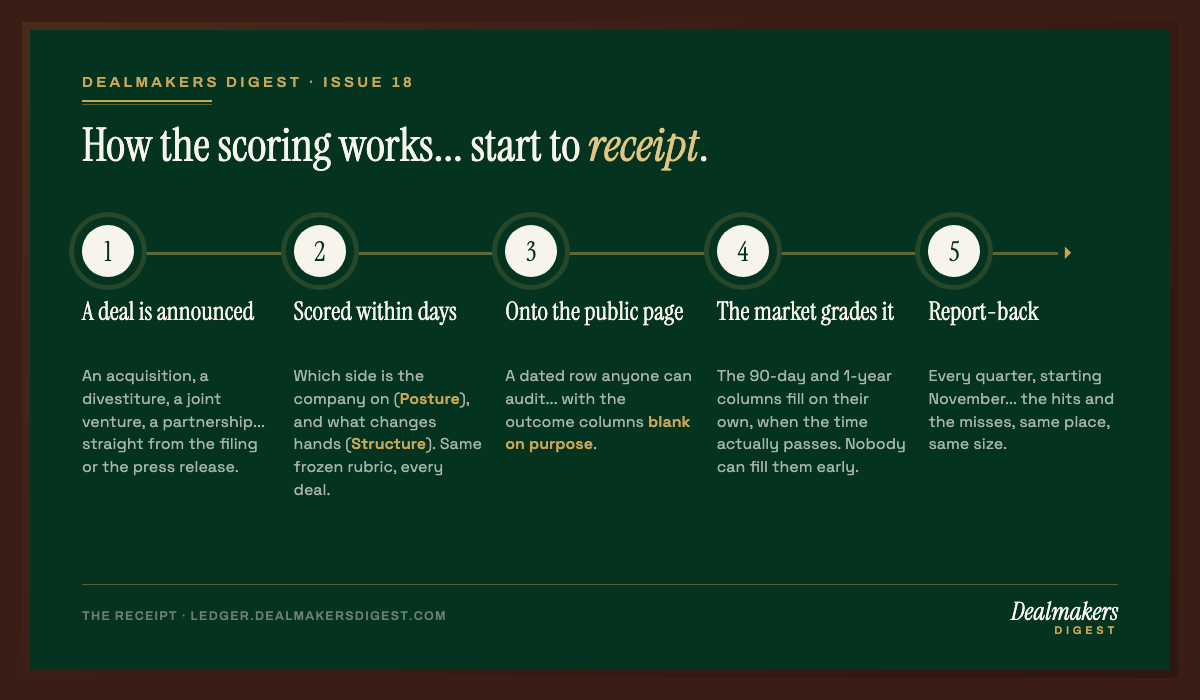
Over the past few months, with the help of Claude and a Mac Mini (and my own eyes: I've personally been through a ton of these deals myself), I pulled the deal announcements of S&P 500 companies (the roughly 500 largest US-listed businesses) across the past five years. Acquisitions. Divestitures. Joint ventures. Partnerships. I built a scoring framework around the small vocabulary you've started seeing at the bottom of my posts: Posture, for which side of a deal a company is actually on, and Structure, for what kind of asset changes hands. And I used the actual stock market as the weighing machine.
Then the fear showed up. What if this whole thing was just my own opinion with extra steps?
So before I let myself read a single result, I ran a blind test with the gates set in advance. I blind-scored 50 deals against my own machine to find out whether it was just my opinion with extra steps. On the 49 that were scorable on role we agreed at Cohen's kappa 0.968, with 0.921 on industry distance and 0.932 on capability overlap, against gates of 0.70, 0.70 and 0.60 that I set before I started.
If kappa means nothing to you, here is the whole test in plain words. Think of it like two teachers marking the same 50 exam papers in separate rooms, with the marking scheme agreed before either of us saw a paper and the pass marks written down in advance so nobody could move the goalposts after. At the end we compared answer sheets. Across roughly 150 separate judgments, we landed differently 4 times. On the graded scales, never by more than a single point. And on the axis everything else rests on, which side of the deal a company was on, once in 49. Kappa is just the honest version of that score: it strips out the agreements two judges would land on by luck. 1.0 is perfect, 0 is a coin flip, and anything above 0.8 counts as near-perfect.
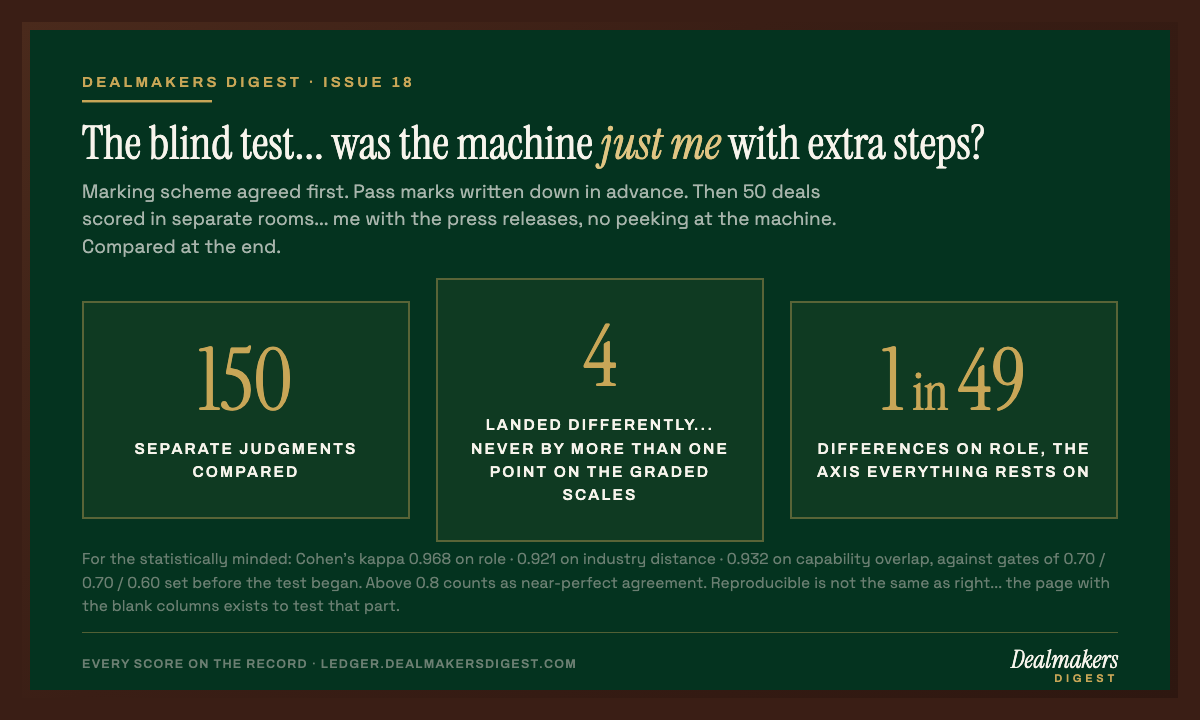
And to be straight about what this does and does not prove: the test shows the scoring is reproducible. The machine and I are the same judge. Whether the judge is right is a different question, and the page with the blank columns exists to answer that one.
And those three dimensions are the whole instrument, two of which you already know. Role is what I call Posture in these pages: which side of the deal a company is actually on. Capability overlap is the machinery behind Structure: whether a deal buys more of the same, buys a missing capability, or creates something new. Industry distance is exactly what it sounds like: how far apart the two companies' worlds are. The vocabulary and the receipts are public. The exact rubric, the anchor document that decides every edge case, stays private.
The Principle
Only then did I look.
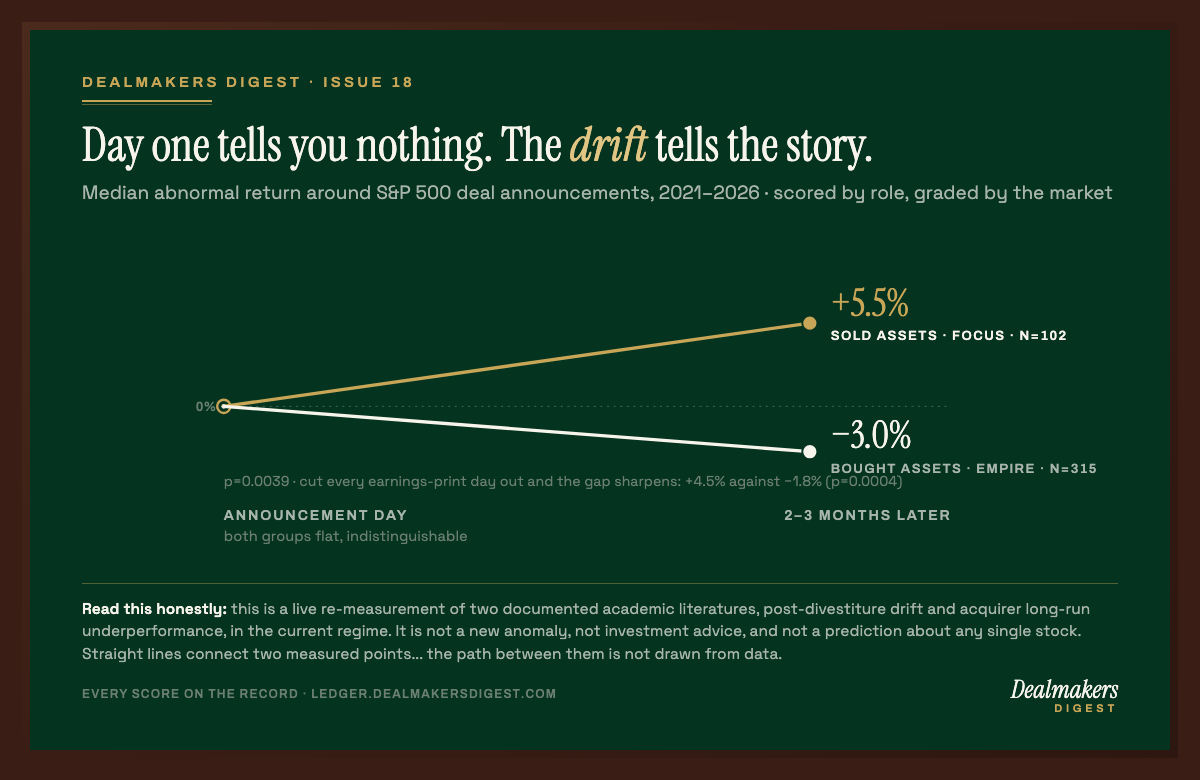
I scored 577 S&P 500 deal announcements from 2021 to 2026. The market's day-one reaction told you nothing about the next quarter. But over the following two to three months, companies that SOLD assets drifted up, a median +5.5% abnormal return across 102 of them, while companies that BOUGHT them drifted down, −3.0% across 315 (p=0.0039). When I cut every earnings-print day out of the window and recumulated, the gap held and got sharper: +4.5% against −1.8%, p=0.0004. This is a live re-measurement of two documented academic literatures, post-divestiture drift and acquirer long-run underperformance, in the current regime. It is not a new anomaly I discovered. It is a research observation about historical market reactions, not investment advice and not a prediction about any single stock.
In plain words: the market slowly rewards focus and slowly taxes empire-building. Not on announcement day, when the headlines are loudest... quietly, over the following months, when nobody is watching anymore.
If you want the originals, they've been sitting in the finance journals for thirty years. In 1992, Agrawal, Jaffe and Mandelker showed that companies making acquisitions went on to lag the market for years afterwards. The academics called it an anomaly and have argued about it ever since. On the other side, Cusatis, Miles and Woolridge found that companies spinning off businesses went on to beat the market for up to three years, and John and Ofek showed sellers of assets improved when the sale made them more focused.
Mine differs in the frame. Those studies were mostly M&A and divestitures, measured over three to five years, on data from the 70s through the 90s. I ran the question over 2021 to 2026, over the next quarter rather than the next half-decade, and across every deal type on one validated instrument: acquisitions, divestitures, joint ventures and partnerships, all scored with the same vocabulary. And instead of stopping at the re-measurement, I put the scoring machine on a public page where the next year of deals gets to grade it.
And the convergence pattern I'd been circling from the start? What I can honestly say today is this: it's an exploratory pattern consistent with the convergence thesis. Not a proven result. I'm treating it as a question the next year of live data gets to answer, in public (and what makes this exercise fun for me).
Two more things I owe you in the same breath. First, the confound I cannot argue away: with dates-only data I cannot rule out that a company chooses to sell assets precisely when it privately expects a good couple of quarters. Cutting every earnings day out of the window handles print-day noise and actually makes the effect stronger. It does not handle this. Second, the limit I ran into everywhere: when I started, I thought I'd end up with something clean... find the deals that worked, see what they had in common, copy it, secret sauce done, like the KFC recipe or Coca-Cola. That is not what came out. Even when a deal is genuinely good, timing matters, the temperature of the economy matters, and there are things underneath all of it I cannot see and probably cannot measure. What I have is directional and never guaranteed. I'd rather let you know in advance.
Personal Principle
A few years ago I worked on a shared-mobility deal in Saudi Arabia. The simple version is that whenever you tap a button, you're able to get a ride. The side I was on brought the technology, the platform thinking, the understanding of how to run a marketplace. The partner brought the heavy assets: the vehicles, and the people who could actually be in them. From an economic point of view the deal made sense. And it still wasn't landing the way it should have.
What was missing was the broader story of how we were actually helping people. Being able to earn more. Making mobility accessible whether you own a car or not. The moment the coin flipped for me was understanding that the partner already makes a lot of money, and money was not the primary motivator. National pride is also a driver of thinking, and it mattered to position The Kingdom as a beacon within the world. The reframe was my idea, but it was prompted by watching their reactions and really understanding what makes them tick. So we made the ecosystem story a core tenet of the deal, not a line at the end of the deck. The deal may have still closed without it, but it wouldn't have gotten enough support across the entire business to make it a super success.
I have believed ever since that deals built that way last longer, that they stand the test of time instead of being just a pop and a fade in the stock market. The scoring engine is that belief, put somewhere the market can grade it.
And there is a part of this that scares me a little. Do all these deals actually matter? Because I think a lot of the time, most of them don't... and that's the problem. If a lot of these partnerships and joint ventures are not having the impact, at least directionally, that goes against what I do on a daily basis. I need to be honest about that. If the data says a particular direction doesn't really work, I'm going to say so, even when it's uncomfortable, because otherwise, why are we all doing what we're doing?
On the record
I want to mention this whilst everything I'm doing still has the possibility of proving me wrong (my framework being tested in public, in real time). If I start to see partnerships and deals that truly create additional value (a new product, a new market, something neither side could do before) and the market cap goes down anyway, then something's wrong, and that's okay. My goal with all of this is to make it transparent and have a conversation about it. That is what the page with the deal ledger is for.
The receipt lives at ledger.dealmakersdigest.com. Every deal I score goes onto that page: the newest ones within days of announcement, before anyone can know how they turn out, and the 90-day and 1-year columns are blank on purpose. The number arrives when it arrives (as per my methodology). The older batch I built and calibrated the system on sits under its own heading, scored after the fact and labelled exactly that way, with how late each one was scored written next to it.
Issue #19 lands Monday 14 September. In November I'll report back on how the live calls actually did... including the misses.
Every deal, scored in public. Before anyone knows how it turns out.
Shavaye