
Deal Spotlight : Nvidia and Intel
How a Fallen Giant and an AI Superstar Found Common Ground

Welcome to my biweekly newsletter covering a range of topics within the deal making space. Join a bunch of curious folks here.
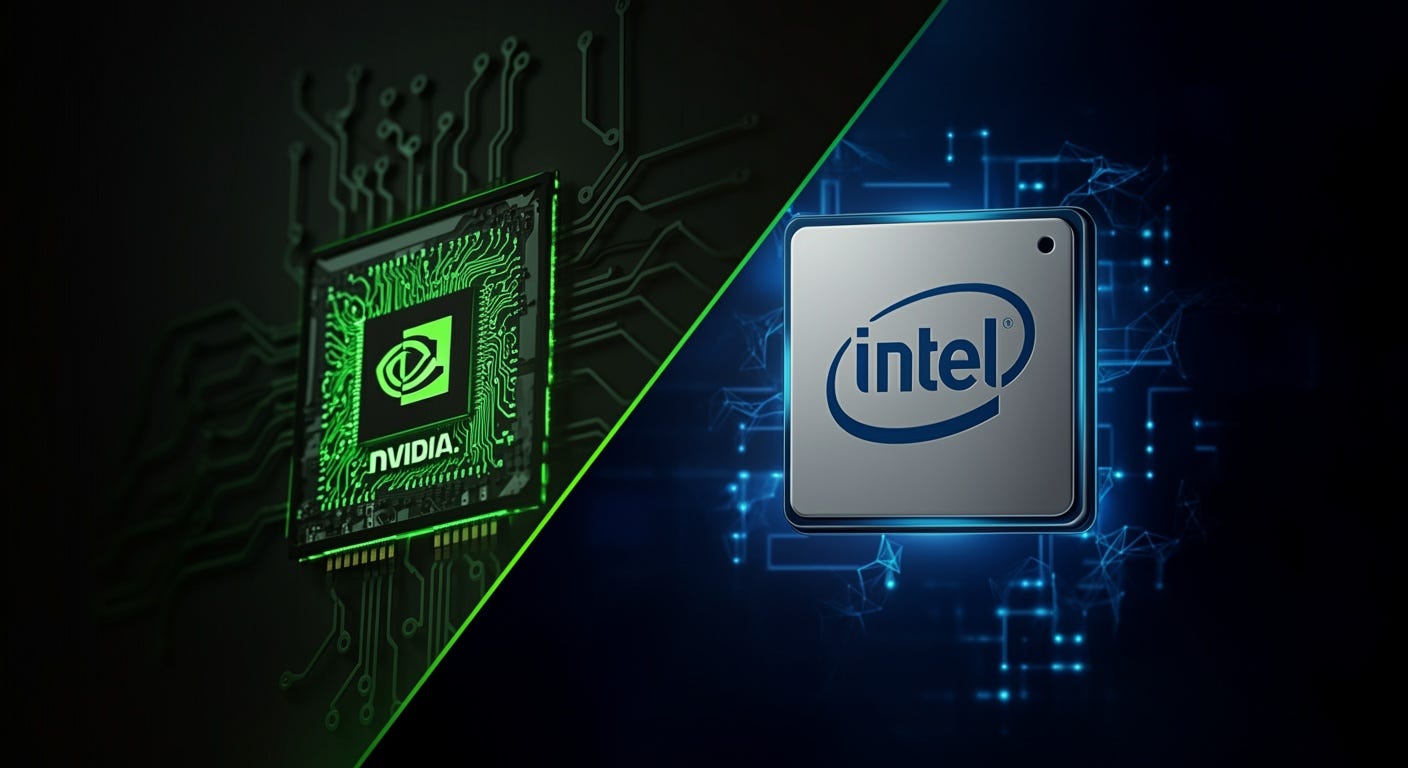
Hi everyone, welcome to a new section of the Deal Maker’s Digest. You may have seen a few of my posts, which are focused on how to become a better deal maker and leader overall. I’m an avid follower of business and technology in general, and I thought I’d look at some of the big partnerships I come across and discuss what I think their strategy is behind the deal. The first one is NVDA 0.00%↑ and INTC 0.00%↑ . I hope you find this as useful as I do. Let’s dive in!
The Setup
Two weeks ago, Nvidia announced it would invest $5 billion in Intel to build the next generation of computing power together. When I first read that and saw how the stock price climbed, my reaction was, “Hmm, that’s interesting.” At first glance, it felt odd, but then I thought this could be a genius move. Nvidia is the golden child of the AI era, while Intel has spent the last decade stumbling through missed bets. Intel had fallen so hard from its all-time glory that I’m not sure anyone thought it could get back up. Of course, President Trump saw this as an opportunity to swoop in like the ultimate swing trader and scoop up a 10% stake in Intel, and the Nvidia deal went through soon after. What’s really going on here? Let’s dive in.
Intel: From “Intel Inside” to Catching Up
If you grew up with a computer in the ‘90s or 2000s, chances are it had a sticker that read Intel Inside. Intel was the beating heart of the PC revolution, powering Microsoft, Dell, and HP. You knew that if you had an Intel-based computer, your games would be running at their optimum. At least that’s what I wanted an Intel-based PC for: Playing Need for Speed II.
Then the world shifted. Intel missed the mobile boom, losing Apple as a partner. It lagged in manufacturing while rivals like TSMC surged ahead. When Apple shifted to its own silicon, I thought it would be a disaster as you had this massive compatibility issue with various apps. But when I looked at the benchmarks of the M1 chip—the latest Apple chip—I decided to buy one and have never looked back. I guess this is also because Apple has a great ecosystem and can optimize for performance so that you’re always getting the best out of your hardware.
And when AI took off, Intel wasn’t leading, it was scrambling to catch up. They’re definitely kicking themselves knowing that they had an opportunity to invest in OpenAI in 2018, when then CEO Bob Swan thought AI would not turn out to be something worth betting on.
Much later on after this miss, they tried buying startups, launching new processors, betting on data centers. But none of it dented Nvidia’s dominance. Intel still had its name, its scale, and its engineers. What it didn’t have was momentum.
Nvidia: From Gaming to Global Power
Nvidia’s story is the opposite. It started making chips for video games. Then researchers realized those same chips were perfect for AI. Nvidia doubled down and built the software, tools, and systems that made its hardware the default choice for training AI models.
Fast forward, and Nvidia has become the beating heart of the AI economy, the supplier everyone depends on. Which makes its next move even more surprising: why team up with a company it once outpaced?
Big Tech like Google, Amazon, Microsoft, Apple, Meta are all designing their own AI chips. AMD, the other U.S. chipmaker, has been gaining ground by offering both processors and graphics chips, positioning itself as a full-stack alternative.
So when the market leader in AI and the lagging legacy player come together, it signals something deeper than a simple investment.
Why These Two Need Each Other
I’ll skip the jargon and explain this the way dealmakers think about it, so I’m going to try and break it down in the simplest way I can. AI requires coordination rather than outright speed. Think of Nvidia’s chips as race cars. They’re fast, but without the right roads and traffic systems, they get stuck. Intel makes the roads, the central processors that organize, direct, and feed data. Nvidia is just starting to make the roads; it has a range of new CPUs about to be released, and no doubt it will be successful integrating these into its architecture.
By pairing up, they can design systems where the “cars” and the “roads” are built to work seamlessly together. Intel is still pretty strong in the PC market with ~$30 billion in revenue, while Nvidia’s PC revenue is just above a third of that with ~$11 billion.
For Nvidia, it’s a form of insurance and expansion. It ensures that it expands deeper into the PC market, where end users like you and I live, and makes sure it uses Intel as the conduit to get there.
For Intel, it’s resurrection. Even if it never catches up in AI chips, being Nvidia’s chosen partner puts it back in the strategic conversation and keeps its core business alive, while giving it a potential strategic lever into the booming data center market.
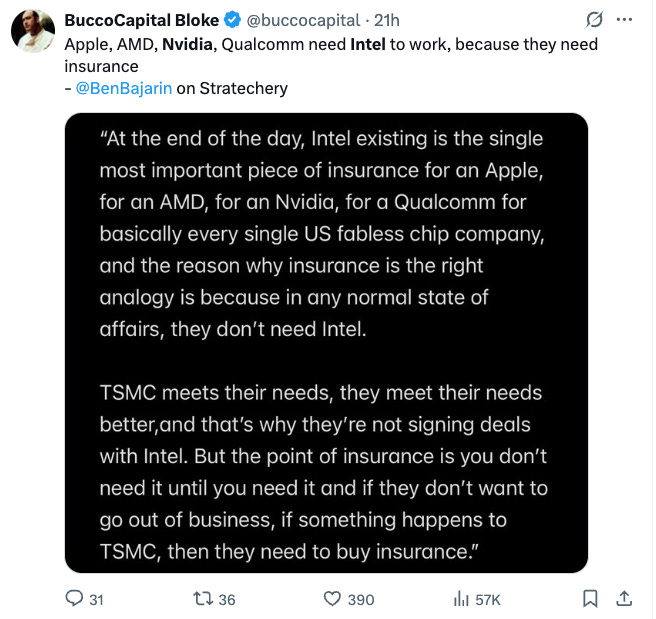
AMD: The Rival in the Wings
Then there’s AMD. Unlike Nvidia, it builds both types of chips, the brains (CPUs) and the muscle (GPUs). It’s been climbing in market share with products that often match Intel on performance at a lower price. Its new AI chips are said to be closing the gap with Nvidia’s latest.
But AMD faces two challenges: it doesn’t have the deep software ecosystem Nvidia has built, and it relies on outside factories (like TSMC) for production, which brings risks in a volatile geopolitical climate.
Still, if any company can rival this new Nvidia-Intel alliance, it’s AMD.
The U.S. Strategy: Building an AI Moat
There’s also a bigger political game at play here. The U.S. government, under President Trump, recently took a 10% stake in Intel. This is a super interesting deal, because Intel had already been promised a large sum of money under the CHIPS and Science Act; however, instead of just providing grants and subsidies, the administration took equity.
By backing Intel, Washington is trying to build an “AI moat” making sure America controls its own chip supply and isn’t dependent on foreign factories.
That adds weight to Nvidia’s decision. Partnering with Intel isn’t just about technology. It’s about aligning with the company the U.S. government has anointed as strategically essential.
The Deal Lesson
I am an absolute fan of the strategy here; it’s like watching a real-time movie play out, linking the political, technological, and future-facing angles.
Nvidia doesn’t need Intel’s brand. But it needs what only Intel can provide: deep access into the PC market.
Intel doesn’t need Nvidia’s money, but it needs Nvidia’s shine to matter again and create a strategic competitive edge to defend against its competitors.
And both know that with Washington watching, alignment creates protection within the political landscape.
This deal reminds me that in any negotiation, the real advantage isn’t speed or dominance, it’s alignment. Nvidia and Intel are building a moat not just of chips, but of influence.
Very well written - thanks for taking the time, doing your research and drafting this piece. I really enjoyed it.