
Circle x OpenMind: When a Robot Dog Pays Its Own Bills
How "Breakthrough Deals" make the impossible feel inevitable and why some partnerships aren't built to scale

Hey Dealmakers,
Before I get into this week’s deal, a quick personal note. I’ve been quiet recently, and that’s mainly because of the challenges in the Middle East at the moment. The Middle East is an amazing place, one I call home. It’s filled with the best people I know, people I call family, friends and colleagues. I have no doubt we’ll all emerge stronger from this.
Okay. Now let me tell you about a deal that completely shifted how I think about what’s coming next.
A robot dog just paid for its own electricity with stablecoins, autonomously. And the two companies that made it happen because they needed the world to believe it could.
That’s a deal-making move I want to break down for you, because the principle behind it is one I’ve used a few times.
Let’s get into it.
🔥 The Dealmakers Spotlight
Circle x OpenMind: How a Robot Dog Paying for Its Own Charging Is Actually a Masterclass in Market Signalling
So here’s the background. Last year, “agentic commerce” was a buzzword. LLMs were getting smarter, everyone was amazed at how much better ChatGPT was getting, but the idea of AI agents actually doing things in the real world, making purchases, managing transactions, operating independently... that still felt like science fiction to most people.
Then 2026 kicked off with a bang. Open Claw took the world by storm. Claude Cowork launched. For those who haven’t tried Open Claw, it’s basically an open source platform that lets you give an AI a laptop and a job description, and it starts learning and doing things for you. I tried it myself, and even without coding experience it blew my mind. You onboard it, input values and preferences, and suddenly you have a new employee getting stuff done while you’re away.
The agentic era arrived faster than anyone predicted. Jack Dorsey announced he’d be laying off roughly 50% of his staff because of it. And then, quietly, Circle and OpenMind announced a partnership that I think is one of the most strategically interesting deals of the year.
The Players
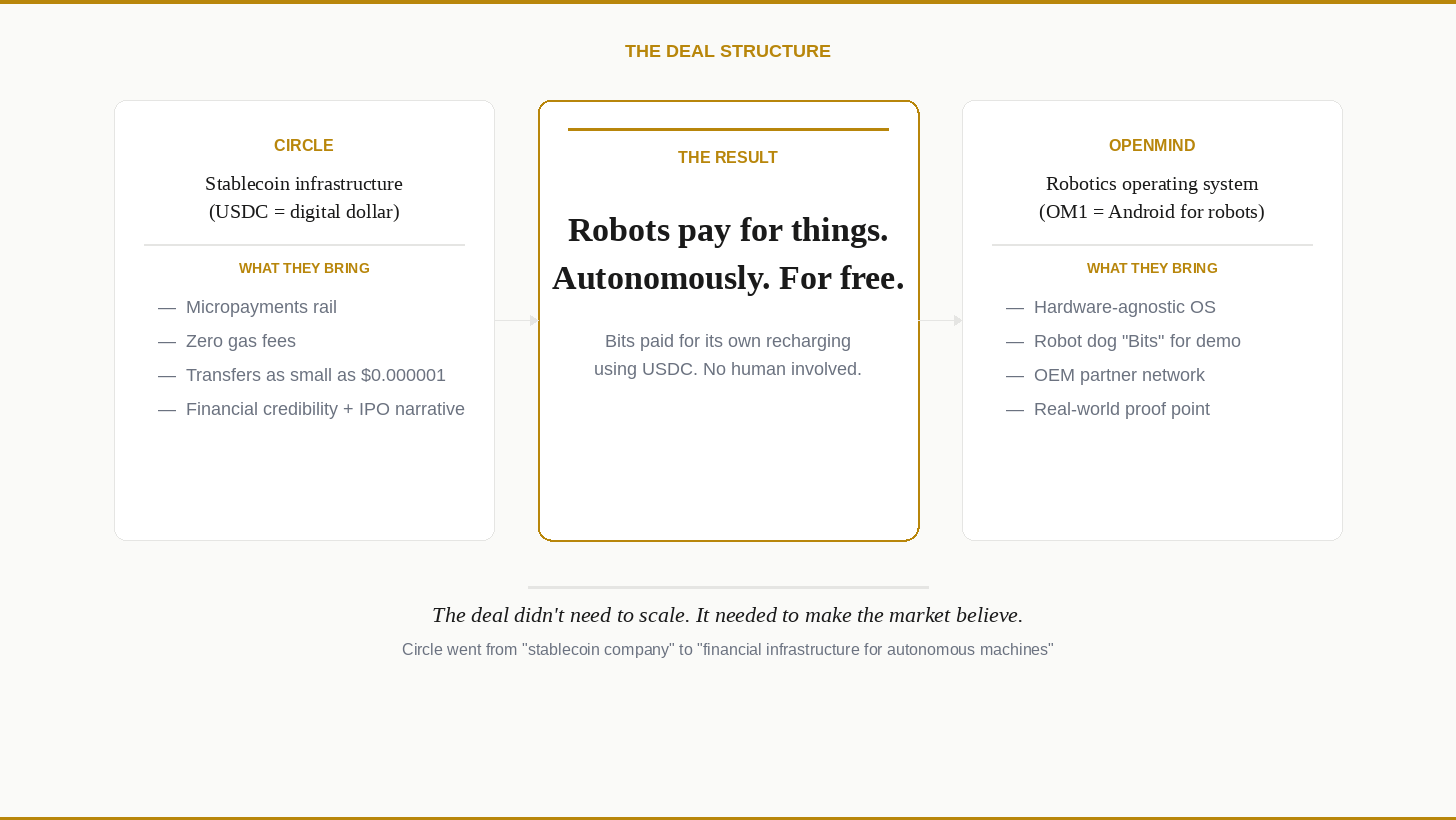
Circle is the company behind USDC (think of it as a digital dollar, backed 1:1 with real USD). But Circle’s ambition is much bigger than just a stablecoin. They want to build the financial infrastructure that lets value move as seamlessly as sending a text message. Today, sending money from one country to another through traditional banking takes days. With stablecoins, it’s basically instant. And if it’s programmable, you can set your own predefined rules, your own ‘contract’, for when and how funds can move.
OpenMind is trying to become the Android of robotics. They’ve built an open-source operating system called OM1 that works across quadrupeds, humanoids, wheeled robots, drones... basically any form factor. The idea is that hardware manufacturers shouldn’t have to build their own software stack from scratch. OpenMind gives them a ready-made brain. They raised $20 million last year from Pantera Capital, Coinbase Ventures, and Ribbit, and they’re already working with manufacturers like Unitree, Agibot, Deep Robotics, and Fourier. Their robot dog named Bits (yes they called it that), the star of this deal’s demo, runs on OM1 and can learn new skills through what’s essentially an app store for robots. Think about that for a second: a hardware-agnostic operating system that lets any robot download capabilities the way you download apps on your phone. That’s the layer OpenMind controls.
The Deal
Circle and OpenMind partnered to integrate Circle’s payments layer directly into autonomous agents. The result: robots and AI agents can now make payments on behalf of themselves or the people who own them. Circle is calling these “Nanopayments”, USDC transfers as small as $0.000001 with zero gas fees. That last part is the game-changer. They’re essentially telling the world: for the millions of tiny transactions that robots and agents will need to make, this will be free.
The demo? OpenMind’s robot dog, Bits, autonomously paid for its own recharging using USDC. No human touched anything.
Why This Matters For Dealmakers
You might be thinking: okay, a robot dog paid for electricity. Cool demo. Why do I care?
Because this deal isn’t really about a robot dog. It’s about market positioning. When Circle listed last year, most people just thought “stablecoin company.” And the problem with being “just a stablecoin company” is that it’s easy to copy. PayPal launched one, others followed. The competitive moat was eroding.
What Circle did with this OpenMind partnership is reframe their entire story. They went from “we make a digital dollar” to “we’re building the financial system that autonomous machines will run on.” That’s a fundamentally different company. A fundamentally different valuation thesis. And they achieved it not through a product launch, but through a partnership.
The deal itself may not scale in the short run. But it doesn’t need to. It needed to make the market believe.
🧠 The Principle
The “Breakthrough Deal”: Using Partnerships to Make the Impossible Feel Inevitable
I’ve lived this one. In the early days of Uber, the platform started with a simple promise: move people from A to B. But the underlying technology was built to move anything around. People, things, food, using any form factor. The world at that time didn’t really understand this. When we talked to people about the platform being capable of so much more, you could see them nodding politely but not really getting it. The future was too far away from what they could picture.
So we did deals that didn’t scale. On purpose. Breakthrough deals.
One of my favourites was Uber Chopper. It was a stunt, honestly pretty clunky at the time, but it showed people something they couldn’t unsee: you could move people through the air using Uber. The form factor didn’t matter. The tech connected it all. And the best part? I got to do this with one of our hero partners in Tanzania, Tigo Telecom. We had a multifaceted deal with them already, and we used the Chopper stunt as a marketing opportunity on top of it. Did it scale into a product? No. But it showed people you could move people in the air using Uber... even in Tanzania.
Fast forward to today and Uber Air is a legitimate product that will be fully commercialised. That’s what a breakthrough deal does. It doesn’t need to be profitable. It needs to make the future feel inevitable.
I see the exact same playbook in the Circle and OpenMind partnership. Nobody believes robots will manage their own money yet. So they showed a robot dog paying for its own charging. The demo is the argument. Just like our chopper was the argument.
This is what I think of as the “Breakthrough Deal.” A partnership designed not to generate revenue in the short term, but to break through the market’s mental barriers. To take a concept that people think is pie in the sky and prove it’s real enough to bet on.
I’ve seen this pattern play out again and again:
Apple and iTunes in 2003. The music labels thought digital distribution was piracy in disguise. Apple didn’t try to argue the point. They partnered with the labels to build a legal storefront and made the future feel safe.
Tesla and Panasonic’s Gigafactory deal. Nobody believed electric vehicles could achieve the battery economics needed for mass adoption. Tesla didn’t just build a factory. They partnered with Panasonic and showed the world the scale was coming.
Uber Chopper. Nobody believed a ride-hailing app could move people through the air. So we just... did it. In Tanzania & a host of other countries around the world. And now it’s becoming a real product.
Circle and OpenMind right now. Nobody believes robots will manage their own money. So they showed a robot dog paying for its own charging. Same playbook, different era.
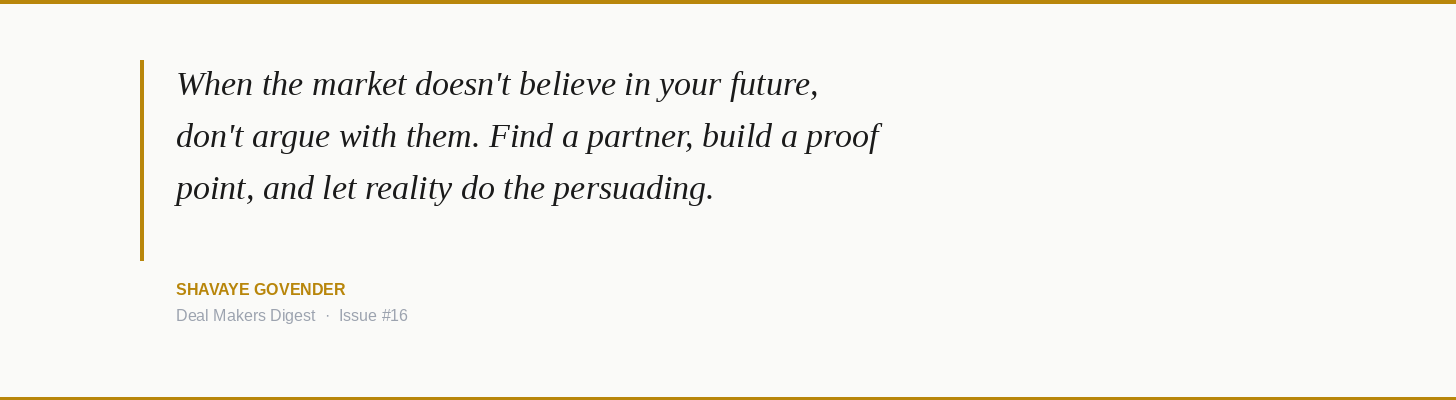
Here’s the principle: when the market doesn’t believe in your future, don’t argue with them. Find a partner, build a proof point, and let reality do the persuading. Analysts rarely believe a new market exists until you show them. So show them.
The deal that changes your company’s story isn’t always the biggest deal. Sometimes it’s the one that makes the impossible feel inevitable.
❓ The Question
Here’s what I’ve been chewing on:
Have you ever done a deal, whether it was a partnership, a pilot, or a proof of concept, where the real goal wasn’t revenue or scale, but changing how the market perceived your company? What happened? Did it work?
Hit reply. I read every single one, and would love to collaborate with you for future editions.
📚 One Thing Worth Reading
“The agentic commerce opportunity: How AI agents are ushering in a new era for consumers and merchants”, McKinsey (2025)
McKinsey is projecting the global agentic commerce market could reach $3–5 trillion by 2030. That’s not a typo. Trillion with a T.
What struck me isn’t the number itself. It’s the infrastructure gap it implies. Right now, the entire payments system is designed for humans. Think about it: you physically check your phone for an authentication code, you use your biometrics for Apple Pay, you click “confirm purchase.” Every step assumes a human is in the loop. If agents and robots are going to transact at the scale McKinsey is projecting, someone needs to rebuild that infrastructure from the ground up. That’s the opportunity Circle is positioning for, and the reason the OpenMind partnership is more strategic than it looks on the surface.
I’d been thinking about this vaguely for months, but this report crystallised it. Worth the read if you’re in BD, partnerships, or commercial strategy anywhere in tech, because the agentic commerce wave is going to create an enormous number of deals over the next five years, and understanding the landscape now gives you a head start.
Shavaye