
AI Doesn’t Replace Negotiators, It Turns Them Into Grandmasters
How to use AI to predict moves, avoid traps, and win before the first handshake.

Welcome to my biweekly newsletter covering a range of topics within the deal making space. Join a bunch of curious folks within the dealmaking space here.

Over the past year, I’ve noticed that a lot of people still treat AI as a fancy search engine. They ask it for facts, maybe a quick summary, or to draft a few lines of copy. But that’s like hiring a full board of advisors and only asking them to fetch you the newspaper. The real power lies in using AI as your strategic counsel — a set of perspectives designed to catch your blind spots before they become missteps. You remain the decision-maker, but with AI as your backstage war room, your odds of making the right call dramatically improve.
Why Chess is the Ultimate Strategic Sandbox
Chess has long been the training ground for strategic thinking. Every move requires you to anticipate consequences, plan several steps ahead, and manage trade-offs under pressure. The board is limited, but the possibilities are infinite. This combination of structure and creativity mirrors the real-world decisions executives face every day — especially in high-stakes negotiations.
My dad first got me into chess. He'd come home late from work, and playing chess was one of the things we'd do together as a family. Yes, I know, super nerdy, but I wouldn't trade it for anything. It's amazing how much it shaped my thinking. I was hooked, and the biggest lesson I learned was that you can always win, no matter what pieces your opponent has or how strong they are. One wrong move (by them or you!) can flip the whole game, so you’ve always got to think ahead, be patient, and play smart.
From the Chessboard to the Negotiation Table
Before any negotiation, I spend a lot of time with the team, simulating various outcomes. This helps me tremendously in terms of my preparation, so we can strategically plan the opening, middle and closing game.
Negotiations, like chess, are about positioning and timing. The key is to know when to attack, when to defend, and when to make a small move that opens the board for bigger plays later. AI can help here by simulating the “game” in advance — predicting counter-moves, mapping your possible strategies, and showing you where you might be walking into a trap.
This isn’t about replacing your instincts or experience. It’s about giving yourself a rehearsal space where you can test approaches without burning political capital in real life. The more you practice, the more automatic your strategic thinking becomes.
How to Prompt AI for Negotiation Simulations
When you're looking for AI to be your negotiation chess buddy, remember: details are key! The more info you throw in, the more spot-on and realistic your simulation will be. Here's a cool trick I use, for example, with ChatGPT: make a new folder for every project or person you're dealing with. That way, the AI keeps tabs on your chat history and uses that whole folder of conversations as context for your deal – seriously, this is a game-changer! So, what should you toss into your prompt?
The players – Who’s involved? Their seniority, cultural background, and decision-making style.
The context – The market environment, internal company politics, and any historical relationship between the parties.
Your goal – What you want in both the short term (the “next move”) and the long term (the “checkmate”).
Constraints – Any non-negotiables, time limits, or political sensitivities.
Possible scenarios – Ask the AI to map out best case, neutral, and worst case outcomes, and the moves leading to each.
Example prompt:
“Act as a world class negotiation coach. I’m meeting with the COO of a Middle Eastern family-owned business. I’m proposing a partnership to launch a new product on Uber. They are process-driven, hierarchical, and the COO has been there 25+ years. He is generally conservative in his approach, risk averse but appreciates new technology breakthroughs. He is the key influencer to the CEO and critical to the long term success of the deal. His colleagues on the board are skeptical of our deal and he faces a lot of challenges from naysayers within the company.
My goal is to get him to trial a new product using existing facilities instead of waiting to launch a full scale business with a new facility, which could take 12 months. In the long term I want him to be vested in rolling out the new facility in a sustainable manner. Map out the negotiation like a chess game: opening, middle, and closing stages, with potential counter-moves and my best responses.”
This will give you a game plan, highlight risks, and even suggest specific phrases to bridge cultural or communication gaps. Don't worry about having the 'right' AI tool; I've tried this across a few of them, so don't let the type of AI hold you back from using this kind of prompt. They all give you enough of what you need to become a better deal maker.
The Chessboard Guide to Closing Deals
Once you’ve got your inspiration and scenario analysis from the response, you’ll find that it gives potential possibilities that you may not have even thought of, this is the game changer. However, if you think an AI can do your job… you haven’t used AI enough. The reality is that AI creates these outputs based on the prompt you’ve provided it and context it has, BUT no one has as much data and reasoning capability as you, the Deal Lead. Use the information as inputs into your broader strategy, not as the strategy itself. To help guide you, I’ve created a set of principles that are related to how the chess game is played below, to help you formulate your strategy.
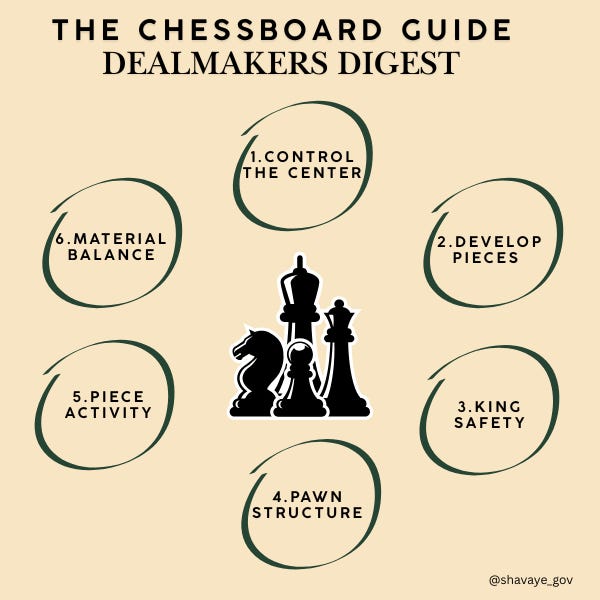
1. Control the Center → Control the Agenda & Key Issues
Chess: The center squares give your pieces maximum mobility and influence. Whoever controls them often controls the game’s flow.
Negotiation: Identify and anchor the conversation around the most influential issues — the ones that shape all other terms (pricing model, delivery timelines, scope). Keep the discussion where you are strongest.
Example: If your advantage is speed-to-market, keep bringing the conversation back to timelines and first-mover advantage instead of letting it drift to cost comparisons.
2. Develop Pieces → Mobilize Your Resources Early
Chess: Don’t leave pieces undeveloped on the back rank; get them active so they can influence the game.
Negotiation: Bring in the right stakeholders, data, and proof points early so they can start influencing the other side’s thinking. Don’t “hold back” critical assets until it’s too late.
Example: Introduce operational experts or share pilot success data in early meetings to create credibility and momentum.
3. King Safety → Protect Your Core Interests
Chess: A vulnerable king is an easy target; keeping it safe prevents disaster.
Negotiation: Know your non-negotiables (budget limits, IP rights, reputational risks) and shield them from unnecessary exposure. Avoid making concessions that could undermine your core position.
Example: If your pilot success hinges on using your existing tech stack, protect that requirement from being negotiated away in side discussions.
4. Pawn Structure → Manage Long-Term Commitments
Chess: Pawns may seem small, but their placement can lock in strengths or create lasting weaknesses.
Negotiation equivalent: Every small concession (payment terms, reporting frequency, minor deliverables) can set long-term precedents. Think about the downstream effect before making changes.
Example: Offering a “one-time exception” on a fee could become the expected standard for all future deals.
5. Piece Activity → Keep Momentum and Influence High
Chess meaning: Inactive pieces can’t help you; active ones exert pressure and create opportunities.
Negotiation equivalent: Keep your proposals, communications, and options in active play so the other side can’t dictate the tempo.
Example: Regularly follow up with value-added insights between meetings so they keep seeing you as the proactive, driving force.
6. Material Balance → Trade Smartly
Chess: Count material constantly; trade when it gives you a positional or tactical advantage.
Negotiation: Be conscious of what you’re giving up and what you’re getting in return. Sometimes it’s worth trading a less important term to gain a decisive advantage on a core issue.
Example: Offer flexibility on start date in exchange for exclusivity in a key market.
Why This Matters More Than Ever
The best negotiators are rarely the loudest in the room — they are the best-prepared. AI is giving us the ability to simulate, rehearse, and refine before the real moment comes. And in doing so, it’s training us to think more strategically, anticipate more clearly, and react more intelligently.
If used well, AI doesn’t just make us faster. It makes us better. It sharpens our judgment, strengthens our adaptability, and accelerates the growth of the one asset that compounds forever: our decision-making ability.
The game is changing. I am personally extremely excited about our future with AI. And for those willing to play chess with AI, the future will be won before they ever sit down at the table.